
Evaluating Executive Personal Cybersecurity for Your Organization
If you're reading this, your organization already recognizes that executive personal exposure is a corporate security issue. The question isn't whether to act - it's how to evaluate the solutions available and select the right one.
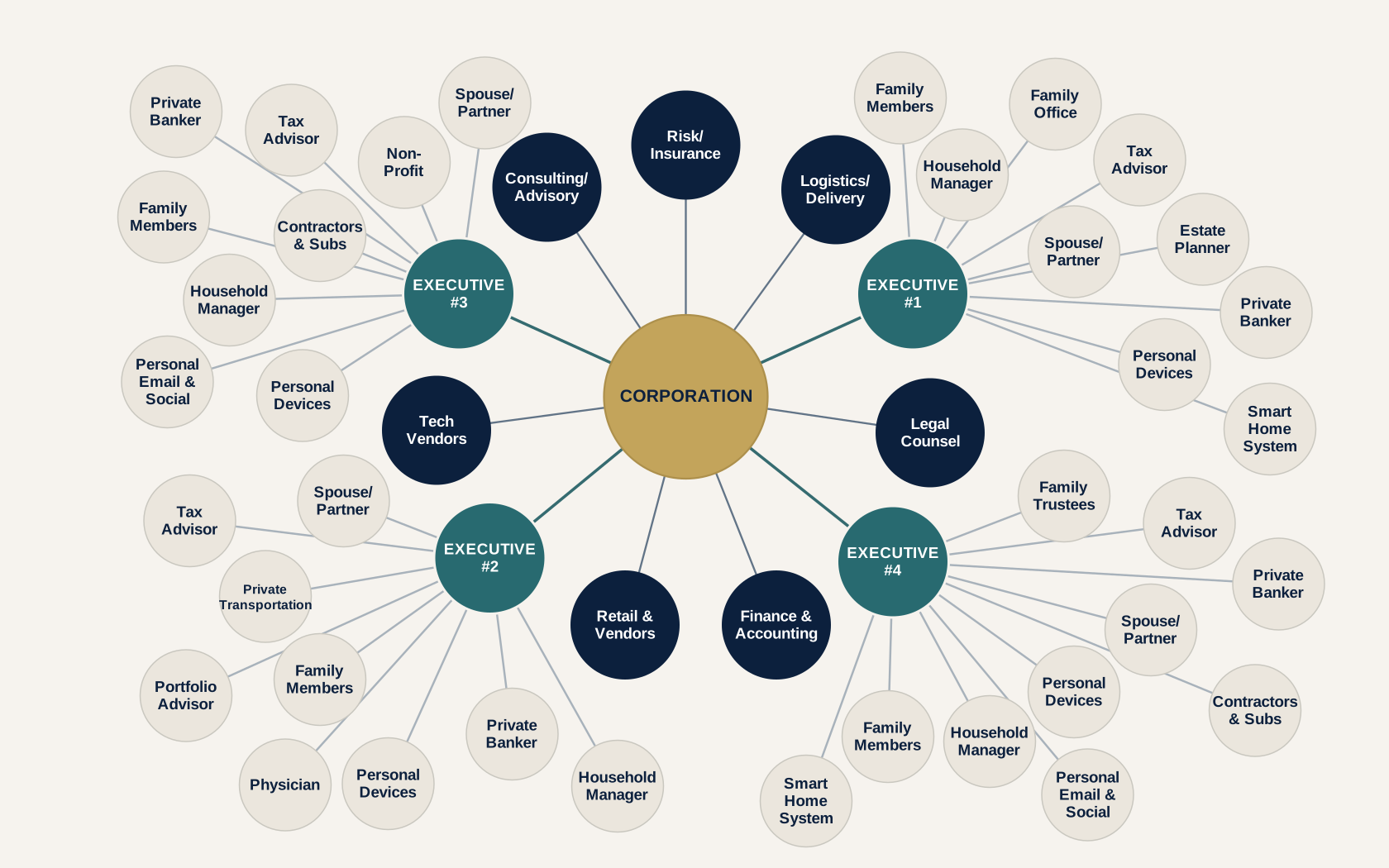
Not all executive cybersecurity programs are the same. Some monitor. Some assess. Some remediate. Very few do all three, and fewer still extend protection across an executive's full personal supply chain - household networks, family members, personal devices, service providers, and the digital footprint that connects them.
This guide provides structured evaluation criteria organized around three perspectives. Each section includes narrative context and an evaluation checklist you can use as you assess solutions.
From Your Company's Point of View
An executive cybersecurity solution should answer this question: Does it reduce the chance that the personal exposure of an executive, board member, or senior leader becomes a financial, operational, legal, reputational, or security problem for the business?
When an executive is compromised through their personal supply chain, the consequences extend to the corporation - exposed data, intellectual property, regulatory disclosure obligations, and board-level scrutiny over whether reasonable steps were taken. This is not an IT problem. It is a governance problem.
The evaluation criteria in this section are designed to help your organization determine whether a solution addresses this gap with the depth, transparency, and accountability the decision requires.
Scope of protection
▾
Not all executive-protection solutions address the same risks. Some focus mainly on monitoring and alerting - scanning the dark web, flagging exposed credentials, and sending notifications. Others provide broader assessment, testing, remediation, privacy protection, family support, and incident response. The difference matters: a monitoring-only solution tells you something is wrong. A complete program fixes it.
Every senior executive has a personal supply chain that falls entirely outside your security mandate. It includes family members, household staff, home networks, personal devices, and connected infrastructure. Threat actors know this and use it. A solution that only monitors part of this surface creates a false sense of coverage. Evaluate for completeness.
Does the solution cover the full attack surface - or just the parts that are easy to monitor?
Personal device and network security
▾
Executives work from personal devices and networks - at home, while traveling, and in environments outside normal IT control. Your home network, cameras, smart devices, Wi-Fi, and connected appliances create more exposure than most families realize. A strong solution should assess and secure the technology executives and their households actually use - not just the devices they carry, but the infrastructure they live in.
Look for solutions that provide on-premise security infrastructure at every residence, not just cloud-based monitoring. A commercial-grade security server installed inside the home can discover every connected device - including the ones the family has forgotten about - and monitor everything on the inside, around the clock. The difference between monitoring from outside and protecting from inside is the difference between knowing about a breach and preventing one.
Does it secure an executive's personal technology, or does it just tell you after something goes wrong?
Administrative and security team visibility
▾
The company needs enough insight to understand and manage executive-related risk, but not so much access that it intrudes into private life. The right solution should create a clear boundary between corporate oversight and personal privacy.
Does the solution help the company understand executive risk while maintaining trust and respecting personal boundaries?
Documentation, support, and guidance
▾
Executive cybersecurity is a sensitive topic. It touches personal devices, home environments, family members, and private information. Companies and executives should not be left guessing how the solution works, what it protects, how onboarding happens, or what support is available when something goes wrong.
Does the solution provide the documentation, people, and process needed to make the program effective - and to earn executive trust?
Automation and operational efficiency
▾
The solution should reduce the burden on the company's IT and security teams. It should not create a new manual process that requires constant chasing, interpretation, and follow-up.
Does the solution make executive protection easier to operate at scale?
Cost and value
▾
The value of an executive cybersecurity solution should be measured against the level of executive risk and the potential business impact of a breach. But it should also be measured against the governance question: did the organization take reasonable steps to protect this exposure?
Boards, legal counsel, and insurers are increasingly asking whether executive personal supply chain risk was addressed. Demonstrable due diligence - quarterly security briefings, risk trend reporting, and documented remediation - matters as much as the protection itself. A solution that cannot produce evidence of risk reduction is a solution that cannot support your governance posture.
Is the cost justified by the reduction in executive, brand, financial, legal, and operational risk?
From Your Executives' Point of View
An executive cybersecurity solution should help senior leaders and their households understand where they are exposed, reduce those exposures, respond quickly to serious issues, and do so in a way that feels supportive rather than intrusive.
Executive cybersecurity is different from corporate cybersecurity in one critical respect: it enters the personal domain. Devices, home networks, family members, household staff, financial accounts - all must be addressed, and all carry an expectation of privacy that corporate security programs are not built for. The solution you select must earn executive trust, not just executive compliance. If the program feels like surveillance, adoption fails. If the program feels like protection, executives and their families become active participants in their own security.
Ease of use
▾
Executives are busy, and some may be less technical. The best solution is one they will actually accept and use.
Will executives see this as useful protection, or as another security burden?
Privacy and trust
▾
Because executive cybersecurity interacts with the personal supply chains of senior leaders, executives must understand what is being monitored, who can see what, and how their information is protected.
Ask about the architecture, not just the policy. A Zero-Knowledge Architecture - where encryption keys are generated and held exclusively on the executive's device, never by the organization and never by the provider - means the provider is technically incapable of accessing, reading, or producing executive data, even if compelled to do so. That is a fundamentally different privacy guarantee than a policy commitment. Look also for strict data isolation practices that keep every individual's data completely separate from any other individual, even within the same household.
Would an executive feel comfortable enrolling personal devices, family members, and household information?
Exposure monitoring
▾
A strong solution should reveal what attackers, fraudsters, or researchers could already discover about an executive. This includes information found in breaches, public records, social media, data-broker sites, criminal marketplaces, or other open sources.
Does the solution reveal what could be used to target, impersonate, pressure, or compromise the executive?
Real-time alerts and recommended actions
▾
Detection is only useful if the executive or the company's security team knows what to do next. Alerts should be understandable, prioritized, and tied to action.
Will the solution explain what matters, why it matters, and what should happen next?
Evaluating Executive Threat Intelligence
The line between digital compromise and physical threat is blurring. An executive's personal supply chain is no longer just a cybersecurity concern - it is a source of actionable intelligence for anyone willing to exploit it.
When an executive's personal supply chain is compromised, attackers gain a targeting package: daily schedules, travel patterns, home access routines, household staff information, and family vulnerabilities. With this intelligence, they can stalk, coerce, gain physical access to secure facilities, or worse. Your CISO secures the corporate network. Your executive protection team secures corporate facilities. But when an executive's personal supply chain is compromised, the risk crosses both cyber and physical domains. That exposure exists outside your mandate, but the corporate risk it creates does not.
Monitor online threats and sentiment
▾
Every organization has detractors, and executives can become focal points for grievances that escalate beyond words. The executives' personal supply chains are now part of your threat landscape - personal device credentials stolen, executive locations and routines exposed, home networks infiltrated, facility access patterns revealed.
A strong solution should continuously monitor across public social media, forums, dark marketplaces, encrypted channels, and fringe platforms - not waiting for a threat to reach the executive, but detecting the shift from passive exposure to active targeting. The difference between raw data and actionable intelligence is the difference between noise and protection. Analysts should brief security leadership in plain language, not data dumps.
Can the solution continuously monitor open-source intelligence and assess the potential for digital hostility to become physical?
Detect doxxing and privacy exposure
▾
Digital vulnerability is the lead-in to real-world harassment, stalking, swatting, protest activity, or physical confrontation. When an executive's home address, family member names, children's school locations, or vacation property addresses are publicly available, those are not privacy concerns - they are physical security threats. Attackers who compromise an executive's personal life don't always stop at data. They gain the intelligence to act in the physical world.
Does the solution account for the specific personal information that creates physical risk?
Prepare for events and travel
▾
Executives are involved in public appearances, earnings calls, product launches, layoff announcements, and speeches that can generate controversy.
Does the solution prepare the organization and its executives for potential issues before they arrive?
Investigate threat actors
▾
When a credible threat is identified, can the solution develop a fuller picture of the individual or group behind it?
Guardian Legacy
Guardian Legacy is a fully managed, enterprise-level cybersecurity service built to secure the personal supply chains of senior executives and their families. It is a complete program - not a platform - with a single point of accountability from assessment through remediation. Legacy addresses the exposure your corporation's security program cannot reach and closes a gap that boards and legal counsel increasingly recognize as a governance issue.
Cybersecurity at this level requires more than monitoring. It requires offense - continuously hunting for exposure, identifying gaps, and eliminating the paths that threat actors rely on before they are used. Guardian operates from the attacker's perspective, actively looking for what is exposed rather than waiting on alerts. We monitor and test continuously to prove that protection is working, so decisions are made with confidence, not assumptions.
Ready to evaluate?
Your cybersecurity protects the company. Guardian Legacy protects your executives at home.
Schedule a Conversation