

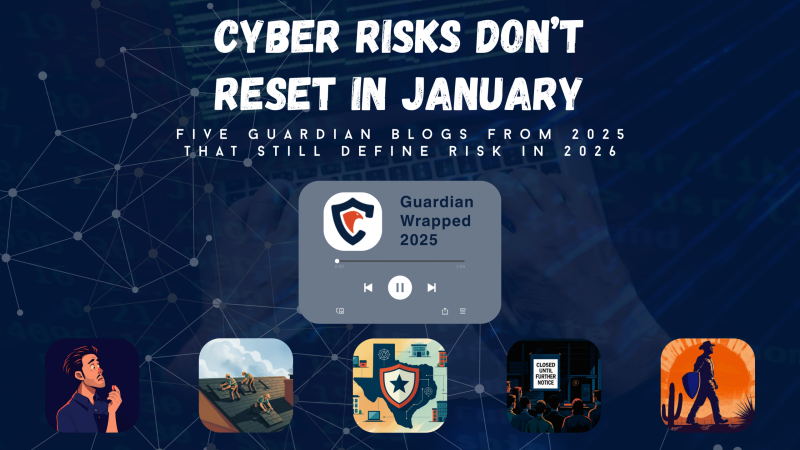
Five Guardian blogs from 2025 that still define risk in 2026
As calendars flip and budgets reset, it’s tempting to assume risk does too. But cyber risks don’t follow the calendar. The same exposures, hidden dependencies, and evolving threats that challenged organizations in 2025 are still out there on January 1 — often harder to see and more complex than ever.
In 2025, we focused on the real reasons cyber risks persist: where visibility fails, assumptions break down, and organizations are expected to prove, not just claim, they’re managing risk responsibly.
If you missed these the first time, or want a sharper lens for 2026, here are five of our blogs from 2025 that remain critically relevant.
#1: Something’s Glitching in Cybersecurity. It’s Time for a Red Pill
Most organizations don’t struggle with cyber risks because they lack tools. They struggle because they rely on simplified models that don’t match how interconnected modern environments have become.
We used the aspen forest analogy to show systemic risk: cloud platforms, vendors, identities, remote access, and SaaS apps all share a single root system. A weakness in one area doesn’t stay isolated—it spreads.
Why it still matters in 2026: Interconnected environments amplify risk. Treating security controls as standalone solutions leaves organizations dangerously exposed.
#2: Patching Is a Solved Issue — Right Up Until It Isn’t
Patching is often seen as “solved.” In reality, it’s one of the most common sources of silent risk.
Even organizations that patch regularly get breached. Missing systems, untracked third-party software, remote endpoints that fail to report—they all create gaps. Attackers don’t need a zero-day exploit. They only need one weak link.
Why it still matters in 2026: As networks become more distributed, the gap between patching efforts and actual risk reduction is growing wider every day.
#3: What SB 2610 Really Means for Texas SMBs
Texas Senate Bill 2610 introduced a cybersecurity safe harbor, but it also highlighted a global trend: organizations are increasingly expected to demonstrate reasonable security practices whether or not a breach has occurred.
This blog breaks down what “reasonable security” really means, why frameworks matter for legal and insurance purposes, and why documentation and continuous monitoring now matter as much as technical controls.
Why it still matters in 2026: Governance and liability are everywhere. Cyber risks aren’t just technical issues. They’re business issues.
#4: Yes! Breaches Happen to SMBs — More Than You Think
Many SMBs still think they’re invisible to cybercriminals. They’re not. SMBs are targeted almost four times more often than large enterprises, and the consequences can be devastating.
Flatter networks, fewer monitoring controls, limited recovery options, and supply chain roles make SMBs attractive and repeatable targets.
Why it still matters in 2026: Automation and specialization make attacking smaller organizations easy, fast, and highly profitable for criminals. Ignoring this reality is a mistake you can’t afford.
#5: The Evolving Landscape of Cyber Threats: How Guardian Stays Ahead
Cyber threats never stop evolving. Ransomware groups get smarter, phishing gets craftier, and attackers are constantly looking for ways around familiar defenses.
Static defenses and periodic assessments are no longer enough. Organizations need continuous visibility, proactive detection, and real-time threat intelligence just to stay in the game.
Why it still matters in 2026: Threats will keep changing. If your risk management strategy doesn’t evolve with them, you’ll be left scrambling, and that window of vulnerability can be costly.
Looking Ahead
Cyber risks don’t end in 2025. They won’t magically reset in January. Organizations that enter 2026 with clear visibility, validated controls, and a realistic understanding of their exposure will be far ahead of those relying on hope and assumptions.
Ready to hunt the hunters in 2026? Follow us this year for actionable insights and strategies to keep your organization one step ahead of cybercriminals.